Solid Wood Cabinets in Bozeman, MT | Solid hardwood frames, doors and edges built to move without cracking
Our team at Custom Cabinets Bozeman MT builds solid wood cabinets with hardwood face frames, rails, stiles and drawer fronts, joined with mortise and tenon and cope-and-stick joints. We pair solid timber where it shows with stable plywood boxes and floating panels, so the wood can move through a Bozeman winter without cracking.
Free design consultationTell us about the room. We call back to book a measure.
Solid Wood Cabinets in and around Bozeman MT
Solid wood gives cabinets depth, warmth and edges that can be sanded and refinished for decades. It also moves with humidity, and in Montana that movement is large. We use solid timber where its strength and beauty matter, and engineer every part so movement is allowed for rather than fought.
Understanding wood movement
Across the grain
Wood moves far more across its width than along its length, so wide parts move most.
Tangential versus radial
Flat-sawn boards move about twice as much as quartersawn boards of the same species.
Species differences
Some woods move more than others. Hard maple moves more than cherry or walnut.
Seasonal cycle
Parts shrink in winter and swell in summer, then repeat every year.
Solid wood done cheaply compared with done right
| The usual approach | How we do it |
|---|---|
| Wide flat-sawn panels glued tight into the frame. | Panels float in their grooves with spacers. |
| Wood used straight from a cold warehouse. | Lumber acclimated in heated storage and checked for moisture. |
| Finish on the front face only. | Every face finished so moisture moves evenly. |
| Solid wood boxes that swell and shrink. | Plywood boxes with solid wood faces. |
Solid wood cabinet construction
- Face frames
- 3/4-inch solid hardwood, typically 1-1/2 to 2 inches wide
- Door frames
- Mortise and tenon or cope-and-stick joints
- Centre panels
- Floating, with rubber spacers in the groove
- Moisture content
- Lumber at roughly 6 to 8 percent before machining
How we build in solid wood
Select
We pick boards for colour, grain and straightness.
Acclimate
Stock rests in heated storage and is moisture-checked.
Machine and join
Frames and doors are cut and joined.
Finish
Every face is finished before assembly.
Where we use solid wood, and why
- Face frames, rails and stiles in solid hardwood for strength and crisp edges.
- Drawer fronts and slab doors in narrow, stable glued-up panels.
- Door centre panels left free to float in their grooves.
- Plywood boxes behind, where stability matters more than looks.
How solid wood cabinets fail
| What goes wrong | Why it happens | What we do about it |
|---|---|---|
| Cracked centre panel | Panel glued into its frame. | Floating panels with spacers. |
| Joint lines opening at door corners | Wood too wet when built. | Lumber dried and acclimated first. |
| Door cups toward the room | Only one face finished. | All faces finished equally. |
Joints that hold for generations
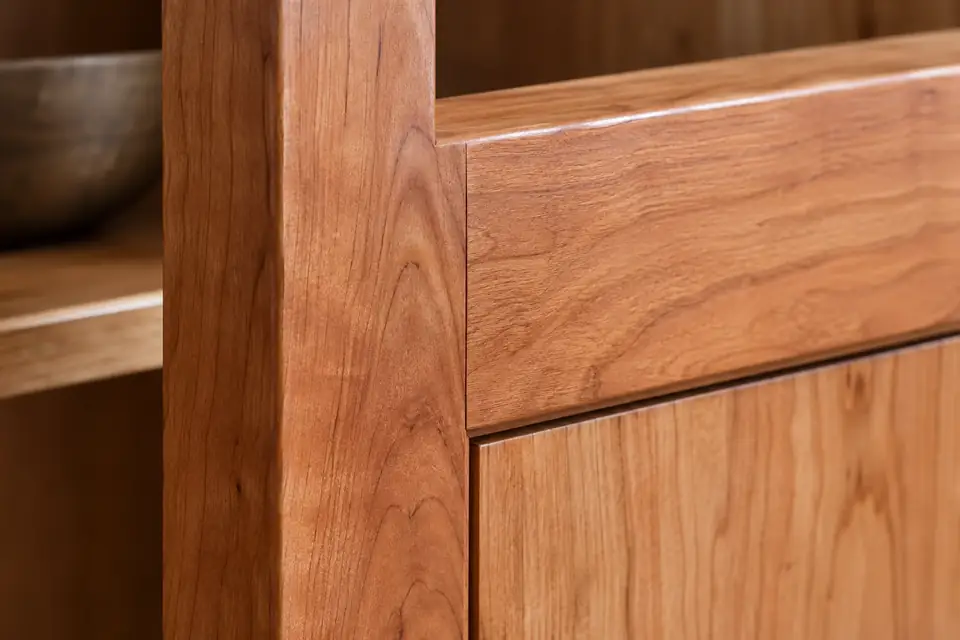
A five-piece door is four frame parts around a centre panel. We join the frame with mortise and tenon or cope-and-stick joints, which lock mechanically and give long glue surfaces. A door built that way stays square even after years of slamming.
The centre panel is not glued. It sits in a groove with room to expand and shrink across its width, held centred by small rubber spacers. That single detail prevents most of the cracked panels and split frames seen in older solid wood kitchens.
End panels and drawer fronts in solid timber
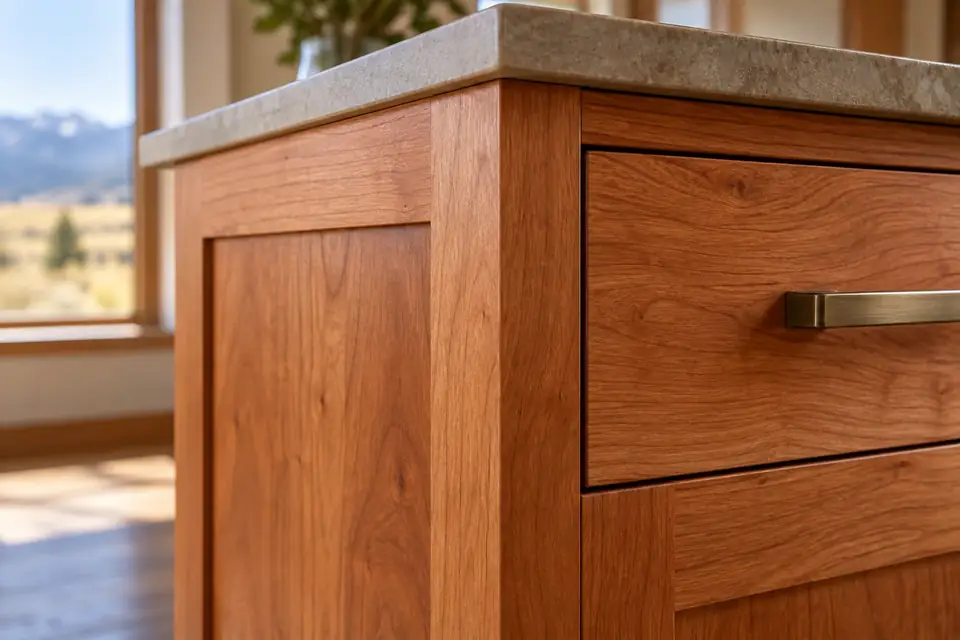
Exposed end panels built frame-and-panel in solid wood look like fine furniture and survive knocks that would chip a veneered panel. Drawer fronts in solid timber have edges you can round over and sand back if they are ever dented.
We glue drawer fronts from narrow boards chosen for matching grain, which keeps them flatter than a single wide board. Grain runs horizontally on drawer fronts and flows from one to the next where the stack is cut in sequence.
Solid Wood Cabinets: terms we use
- Mortise and tenon
- A joint where a tongue on one part fits into a matching slot in another. It is one of the strongest frame joints in woodworking.
- Cope and stick
- A matched pair of router profiles that let door rails and stiles interlock with a decorative edge. Common on shaker and raised panel doors.
- Floating panel
- A centre panel set loose in a groove so it can expand and contract without cracking the door frame.
- Moisture content
- The weight of water in wood as a percentage of its dry weight. Interior woodwork is built at roughly 6 to 8 percent.
Solid wood is not always best
For painted cabinets, solid wood centre panels show movement lines each winter. There we recommend MDF panels inside solid frames, which look identical and do not move.
For large flat surfaces such as wide end panels and tall pantry doors, veneered plywood often performs better than solid wood. We will recommend what suits each part.
Wood stoves and solid wood cabinets
Many homes outside Bozeman heat partly with a wood stove, which drives down humidity in the room around it. Solid wood cabinets near a stove dry out faster than those across the house, and doors closest to the heat can shrink and open joint lines first.
Where a kitchen shares a room with a stove, we keep solid panels on the far side, use stable constructions near the heat, and recommend a humidifier or a pot of water on the stove top to temper the air through winter.
Wood stove clearances to combustibles come from the stove maker, and cabinets must respect them like any other wooden item near the firebox.
Solid wood at 4,820 feet
The Architectural Woodwork Institute notes that relative humidity must average between 25 and 55 percent to hold wood at 5 to 10 percent moisture content. A heated Bozeman house in January can fall below that range, and wood responds by shrinking.
A 15-inch-wide flat-sawn panel can shrink by a noticeable fraction of an inch across a winter. If that panel is glued tight, something has to crack. If it floats, it simply moves inside its groove and nobody notices.
Before choosing solid wood
- Your preferred species and colour.
- How much sun the cabinets will get.
- Whether the house has a humidifier.
- Whether you want stain, clear or paint.
What moves the cost of solid wood cabinets
Solid wood work costs more than veneer or paint-grade construction. These are the main reasons.
Species and grade
Clear, straight hardwood costs more, and figured boards more still.
Waste
Selecting for colour and grain means more offcuts.
Joinery
Mortise and tenon doors take longer than simpler constructions.
Questions about solid wood cabinets
Are solid wood cabinets better than plywood?
For faces, frames and doors, solid wood is excellent. For boxes, plywood is usually better because it is more stable and holds its shape in dry winters. We build boxes from plywood and faces from solid wood to get the best of both.
Do historic district rules or permits in Bozeman affect new wood cabinets?
No. Bozeman design review for historic areas and the neighbourhood conservation overlay concerns exterior changes. Interior cabinets are finish work exempt from building permits under IRC R105.2. Plumbing or electrical changes still need city permits.
Will solid wood cabinets crack in a Montana winter?
Not if they are built to move. Floating panels, acclimated lumber and finish on every face let the wood shrink and swell without cracking. Cracks come from panels glued tight or wood built too wet.
What is the most stable solid wood for cabinets?
Quartersawn and rift-sawn boards are the most stable in any species. Among species, cherry, walnut and mahogany move less than hard maple or beech. We choose cut and species together.
Can solid wood cabinets be refinished later?
Yes. Solid wood can be sanded and refinished several times, which is one of its big advantages over veneer and laminate.
Why do solid wood doors show a light line at the panel edge?
That line appears when the panel shrinks in winter and exposes wood that was hidden in the groove. We prefinish panels before assembly so no raw wood is exposed when they move.
Do solid wood cabinets need special care?
Keep indoor humidity steady if possible, wipe spills promptly and avoid harsh cleaners. A humidifier in winter helps the whole house, including the cabinets.
Can I get solid wood cabinets painted?
Yes, but painted solid panels show seasonal lines. We build painted doors with solid frames and MDF panels, which look the same and stay crack-free.
Is solid wood heavier than plywood?
Solid hardwood is dense, and solid doors are heavier than MDF or veneer doors. We size hinges for the weight, often adding a third hinge on tall doors.
How long do solid wood cabinets last?
Well-built solid wood cabinets can last for generations. The finish may need renewing over the years, but the joinery and timber can outlast the house.
Work that pairs with solid wood cabinets
Solid wood work connects to species choice and finishing. These services go with it.
- Hardwood Cabinetry
- Custom Stained Cabinets
- Shaker Style Cabinets
- Custom Cabinet Fabrication
- Kitchen Cabinets
- Live-Edge Wood Cabinetry
Real timber, engineered for a dry climateSolid hardwood frames, doors and fronts, built to move without cracking.
Call 406-521-7523