Cabinet Box Construction: Plywood, Particleboard and Formaldehyde | What is inside a cabinet, and why it matters
At Custom Cabinets Bozeman MT, we build cabinet boxes from 3/4-inch plywood that meets federal formaldehyde limits. This guide explains how plywood compares with particleboard and MDF, what the EPA TSCA Title VI rule requires, and which construction details decide whether a cabinet lasts.
Free design consultationTell us about the room. We call back to book a measure.
What a cabinet box does
The box carries the load of countertops, dishes and appliances, holds hinges and runners in place, and keeps everything square. Doors and finishes get the attention, but the box decides how well a cabinet works over the years.
Plywood, particleboard and MDF
| Material | Strengths | Weaknesses |
|---|---|---|
| Plywood | Strong, light, holds screws well, handles moisture better | Costs more, edges need banding |
| Particleboard | Flat, inexpensive, consistent | Heavy, weak at screws, swells badly when wet |
| MDF | Very flat and stable, paints smoothly | Heavy, poor screw holding at edges, swells when wet |
Plywood is made from thin veneers glued in alternating grain directions, which gives strength and stability. Particleboard and MDF are made from wood particles or fibres bonded with resin. They are flat and cheap, but they swell and lose strength when wet, which is why particleboard sink bases fail first.
MDF has a place: it is ideal for painted door panels because it barely moves with humidity. It is less suited to boxes, where screw holding and moisture resistance matter more.
Formaldehyde and the TSCA Title VI rule
Many composite wood products use resins that can release formaldehyde. The EPA formaldehyde emission standards for composite wood products, under Title VI of the Toxic Substances Control Act and codified at 40 CFR Part 770, set limits for hardwood plywood, particleboard and MDF sold or used in the United States.
| Product | Limit (ppm) |
|---|---|
| Hardwood plywood | 0.05 |
| Particleboard | 0.09 |
| Medium-density fibreboard | 0.11 |
| Thin MDF | 0.13 |
Since March 22, 2019, composite wood products and finished goods containing them must be labelled as TSCA Title VI compliant. The limits match the earlier California CARB Phase 2 standard, which is why older literature often mentions CARB 2.
Ask for TSCA Title VI compliance on any cabinet quote. It is a legal requirement for products sold in the United States, and a reputable supplier will confirm it.
Construction details that matter
- Box sides of 3/4-inch plywood rather than 1/2-inch or 5/8-inch.
- Bottoms and fixed shelves set in dado joints, glued and screwed.
- Backs set in rabbets or grooves so the box stays square.
- Finished interiors that are easy to clean.
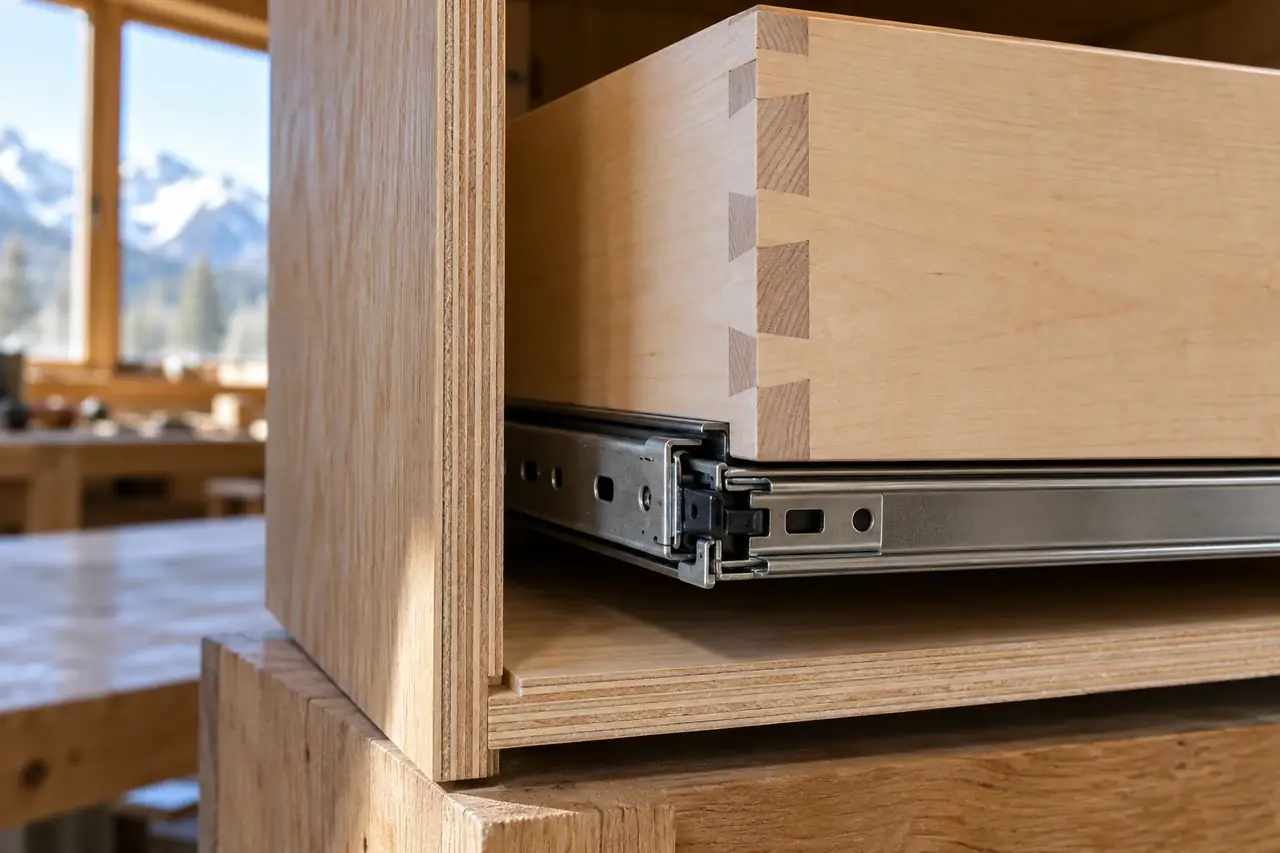
- Dovetailed drawer boxes with captured bottoms.
- Runners rated for the load, such as Blum TANDEM at 30 kg or MOVENTO at 40 or 70 kg dynamic load.
Why plywood suits Bozeman
Plywood cross-banded construction makes it much more dimensionally stable than solid wood, so boxes stay square through dry winters and humid summers. It also resists water better than particleboard, which matters under sinks, in laundry rooms and in mudrooms where snowmelt arrives on boots.
Drawers and runners
Drawers get the hardest use of any part of a cabinet. Dovetailed boxes with bottoms captured on four sides resist racking and sagging. Blum publishes dynamic load classes for its runners: TANDEM at 30 kg and MOVENTO at 40 or 70 kg. Note that Blumotion is the soft-close mechanism, not a load rating.
What to ask a cabinet maker
- What are the boxes made of, and how thick?
- Are the materials TSCA Title VI compliant?
- How are the boxes joined?
- What drawer construction and runners do you use?
- Are interiors finished?
Edges, backs and toe kicks
Plywood edges show the layers of veneer, so exposed edges are covered with solid wood or veneer banding. Backs matter too: a 1/4-inch back set in a groove or rabbet keeps the box square, while a thicker back gives solid fixing for wall cabinets. Toe kicks can be built into the cabinet sides or made as a separate plinth, which makes levelling on uneven floors easier and lets the kick be replaced if it is damaged by mopping or snowmelt.
Sink bases and wet areas
The sink base is where cabinets fail first. Small drips from traps, supply lines and dishwasher connections soak into the cabinet floor, and particleboard swells, crumbles and grows mould. Plywood resists much better, and sealing its edges and adding a removable mat or tray adds protection. In laundry rooms and mudrooms, where water arrives from machines or boots, the same approach applies.
Frameless and face-frame boxes
Box construction applies to both frameless and face-frame cabinets. Frameless boxes rely entirely on the box for rigidity, so thick sides and good joinery matter most. Face-frame boxes gain stiffness from the solid wood frame on the front, but the box still carries the load and holds the hardware. Our guide to frameless, face-frame and inset cabinets explains the differences in look and storage.
How long a well-built box lasts
A plywood box with good joinery, sound hardware and a durable finish can outlast several countertops and several changes of door style. That is why refacing works: when the box is sound, only the visible parts need replacing. A weak box, by contrast, limits every future option.
Sources
- U.S. Environmental Protection Agency, Formaldehyde Emission Standards for Composite Wood Products, 40 CFR Part 770 (TSCA Title VI).
- EPA, Formaldehyde Emission Standards compliance and labelling dates.
- Blum, TANDEM and MOVENTO runner system specifications (dynamic load classes).
- USDA Forest Products Laboratory, Wood Handbook, chapter on wood-based composite materials.
Cabinet box construction guide: questions
Follow-up questions on cabinet box materials and formaldehyde standards. For what we build, start at the Custom Cabinets Bozeman MT home page.
Is plywood better than particleboard for cabinet boxes?
For most uses, yes. Plywood is stronger, lighter, holds screws better and handles moisture better. Particleboard is flat and cheap but swells when wet.
What is TSCA Title VI?
It is the federal rule setting formaldehyde emission limits for hardwood plywood, particleboard and MDF, codified at 40 CFR Part 770 and enforced by the EPA.
What are the TSCA Title VI formaldehyde limits?
Hardwood plywood 0.05 ppm, particleboard 0.09 ppm, MDF 0.11 ppm and thin MDF 0.13 ppm.
Is CARB 2 the same as TSCA Title VI?
The limits are the same. CARB Phase 2 was California rule, and TSCA Title VI applies the equivalent limits nationally.
When did TSCA Title VI labelling become mandatory?
Labels showing TSCA Title VI compliance have been required on composite wood products and finished goods since March 22, 2019.
Why do particleboard sink bases fail?
Particleboard swells and loses strength when wet, and small leaks under sinks are common. Plywood holds up much better.
Is MDF good for cabinets?
MDF is excellent for painted door panels because it is stable. It is less suited to boxes because it swells when wet and holds screws poorly at edges.
What load can cabinet drawer runners carry?
It depends on the runner. Blum publishes dynamic load classes such as 30 kg for TANDEM and 40 or 70 kg for MOVENTO.
Is Blumotion a load rating?
No. Blumotion is the soft-close damping mechanism. Load ratings come from the runner system, such as TANDEM or MOVENTO.
Do plywood cabinet boxes need to meet any building permit requirement?
No. Cabinets are exempt from building permits under IRC R105.2. The materials must still meet the federal TSCA Title VI formaldehyde limits, which is a product rule enforced by the EPA rather than part of a local permit or inspection.